COM-540: Identity & Personal Brands · Southern New Hampshire University

Identity, Purpose, and Presence

Connecting who I am with what I create.

Eric Bryden | Founder of Draconic Realms Creations | Draconic1967

Introduction

Overview

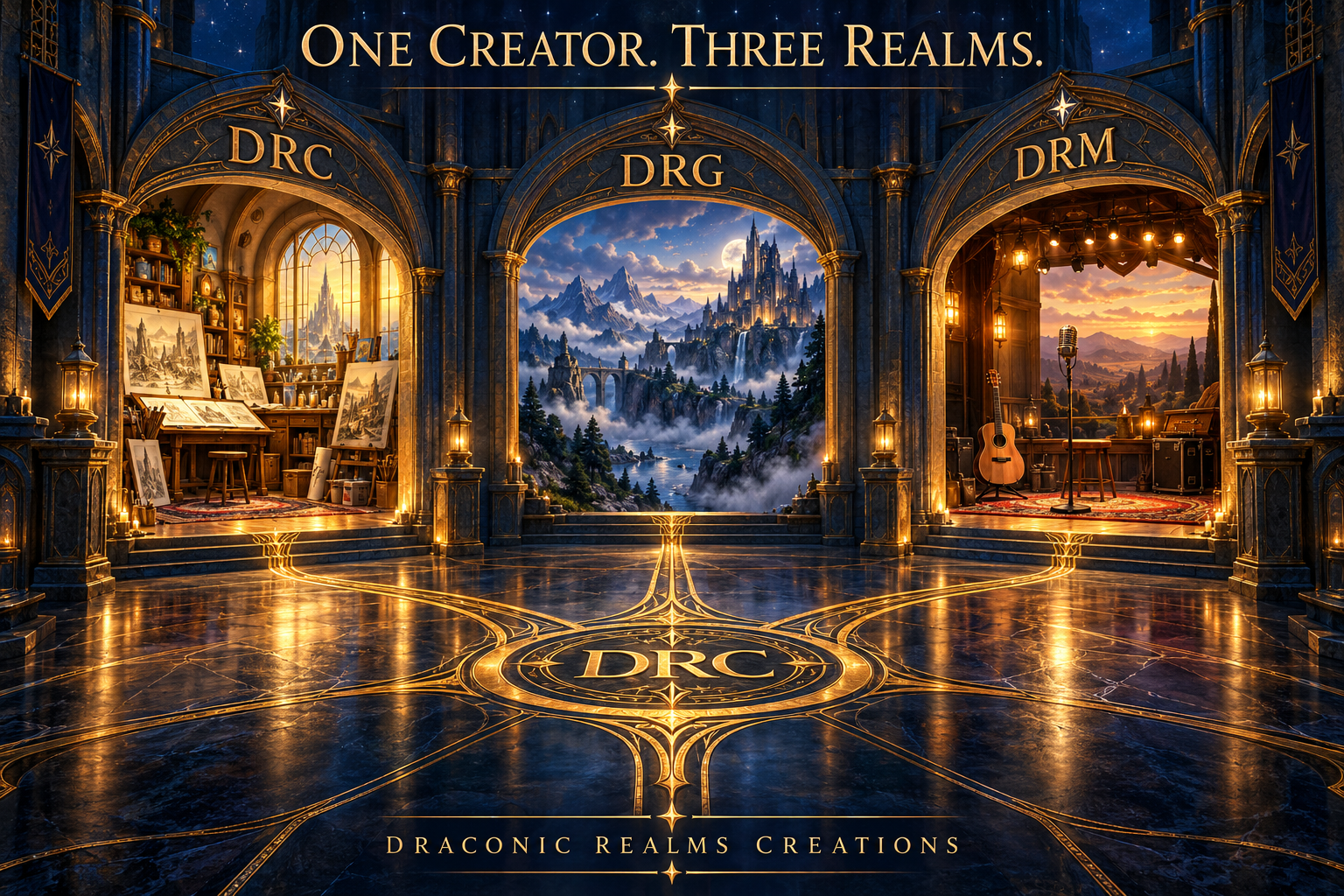
My online presence brings together my creativity, my experiences, and the work I want to build. Through Draconic Realms Creations, Draconic Realms Gaming, and Draconic Realms Music, I am developing a brand that represents me personally and professionally. This project explores how I can share my story honestly, communicate responsibly, and create meaningful connections with different audiences.

My Draconic Realms Creations (DRC), Draconic Realms Gaming (DRG), and Draconic Realms Music (DRM) websites remain under development as I apply what I learn throughout my master’s degree in communication.

Course
COM-540: Identity & Personal Brands
Institution
Southern New Hampshire University
Student
Eric Bryden, also known as Draconic1967
Instructor
Dr. Andrew West

Course assignments are submitted separately in the formats required by SNHU.

One founder, three connected identities

My Brand

A brand is the understanding people develop about who I am, what I offer, and what they can expect from my work. Logos and colors help people recognize me, but my actions, communication, creative choices, and consistency shape that understanding.

DRC

Draconic Realms Creations

Role: The central professional brand.

Focus: Creative communication, digital media, storytelling, academic projects, and professional portfolio work.

Visit website

DRG

Draconic Realms Gaming

Role: My gaming and entertainment identity.

Focus: Gaming adventures, character storytelling, creative builds, community, and game-inspired media.

Visit website

DRM

Draconic Realms Music

Role: My musical and personal storytelling identity.

Focus: Country, soul, rock, rap, and combinations of these styles.

Visit website

Each branch has its own audience and creative focus, but all three connect back to me and the values behind Draconic Realms Creations.

Supporting: Suno Application Portfolio — an independent portfolio, not an official Suno partnership.

Proposed — to confirm against earlier submissions

Three Branding Goals

These are proposed goals. They are not marked completed or instructor approved.

Goal 1: Connect My Three Websites

Proposed

By the end of COM-540, establish clear connections among DRC, DRG, and DRM, with consistent founder identification, working navigation links, and a clear purpose for each website.

Why: Help visitors understand my work and move between my professional, gaming, and music identities.

Evidence: Website screenshots, brand descriptions, navigation links, and a completed link review.

Research connection: Consistent presentation and ongoing maintenance (Gorbatov et al., 2018); audience awareness and perceived identity (Labrecque et al., 2011).

  • Website connections completed: not yet provided
  • Link review result: not yet provided

Goal 2: Develop Three Music Album Projects

Proposed

Develop and document three album projects that communicate different parts of my identity, including their themes, selected songs, cover artwork, and descriptions. Distinguish planned work, work in progress, and published releases.

Why: Use music and storytelling to communicate who I am personally while demonstrating my creative process professionally.

Evidence: Album concepts, track lists, artwork, song descriptions, production credits, and published links where available.

Research connection: Differentiation through narrative and imagery (Gorbatov et al., 2018). Applying this to album projects is my interpretation, not a demonstrated outcome.

  • Album concepts documented: not yet provided
  • Published releases: not yet provided

Goal 3: Establish a Responsible Content Practice

Proposed

By the end of COM-540, document and apply a content review process covering audience relevance, factual accuracy, source attribution, privacy, respectful communication, and clear descriptions of AI assistance.

Why: Build trust while managing the overlap between personal expression and professional responsibility.

Evidence: A content checklist, original and curated examples, attribution, disclosure examples, and reflection notes.

Research connection: Ongoing evaluation (Gorbatov et al., 2018) informs my review practice; ethics, attribution, and AI transparency are my applications and require further targeted research.

  • Items reviewed with checklist: not yet provided
  • Content review results: not yet provided

Supports Journal 3-2 and both final projects

Research & Best Practices

Systematic literature review · Peer review verified

Personal Branding: Interdisciplinary Systematic Review and Research Agenda

Sergey Gorbatov, Svetlana N. Khapova, and Evgenia I. Lysova (2018). Frontiers in Psychology, 9, Article 2238

Main finding: Personal branding is strategic and audience-directed, differentiated through narrative and imagery, and requires ongoing evaluation and maintenance.

Applies to my brand: Connect my values with presentation and creative work across DRC, DRG, and DRM; maintain a consistent founder identity and periodically review content.

Research limits: A synthesis does not guarantee a particular creator’s success; applications may differ across creators.

Link / DOI

Mixed-method study · 12 participants · Peer review verified

Online Personal Branding: Processes, Challenges, and Implications

Lauren I. Labrecque, Ereni Markos, and George R. Milne (2011). Journal of Interactive Marketing, 25(1), 37–50

Main finding: Comparisons of participants’ self-perceptions of profiles with external evaluations indicate that branding efforts may be insufficient or misdirected; managing multiple audiences is challenging.

Applies to my brand: Gather visitor feedback about my values, creative abilities, and professional goals; distinguish my intended identity from visitors’ perceived impressions.

Research limits: The small sample of 12 people limits generalizability; these findings do not establish outcomes for my websites.

Publisher metadata and abstract verified; no full-text access is claimed. No additional results are inferred.

Link / DOI

Research themes

  • Authenticity

    Distinctive self-presentation: Gorbatov et al. (2018); further research needed on authenticity outcomes.

  • Consistency

    My cross-site application of strategic presentation: Gorbatov et al. (2018).

  • Audience awareness

    Intended versus perceived identity: Labrecque et al. (2011); small sample limits generalizability.

  • Ongoing maintenance

    Continued evaluation and maintenance: Gorbatov et al. (2018).

  • Personal and professional boundaries

    Multiple-audience challenges: Labrecque et al. (2011); further boundary-specific research needed.

  • Context collapse

    Further targeted research needed; not verified by these two summaries.

  • Ethical communication

    Eric’s application; further targeted research needed.

  • Original and curated content

    Eric’s content decisions, not a verified finding of these studies.

  • Transparency about creative methods

    Eric’s disclosure practice; further targeted research needed.

Final Project I Milestone Two

Identity Case Studies

Fact fields hold documented, sourced information. Analysis fields hold my interpretation.

Case Study One

Selection Pending
  1. Person and professional roleFact
  2. Incident and dateFact
  3. Verified account of what occurredFact
  4. Personal identity expressedAnalysis
  5. Professional identity or expectations involvedAnalysis
  6. How online audiences encountered the conflictAnalysis
  7. Authentic self and professional identity analysisAnalysis
  8. Research-based principles appliedAnalysis
  9. Ethical implicationsAnalysis
  10. Professional standards and evidenceFact
  11. My assessment of whether those standards were followedAnalysis
  12. Recommended improvementsAnalysis
  13. How the recommendations improve the brand messageAnalysis
  14. Lessons for DRC, DRG, and DRMAnalysis
  15. Sources and APA citationsFact

Case Study Two

Selection Pending
  1. Person and professional roleFact
  2. Incident and dateFact
  3. Verified account of what occurredFact
  4. Personal identity expressedAnalysis
  5. Professional identity or expectations involvedAnalysis
  6. How online audiences encountered the conflictAnalysis
  7. Authentic self and professional identity analysisAnalysis
  8. Research-based principles appliedAnalysis
  9. Ethical implicationsAnalysis
  10. Professional standards and evidenceFact
  11. My assessment of whether those standards were followedAnalysis
  12. Recommended improvementsAnalysis
  13. How the recommendations improve the brand messageAnalysis
  14. Lessons for DRC, DRG, and DRMAnalysis
  15. Sources and APA citationsFact

Course order

Assignment Roadmap

Module Two · 2–3-page paper

Final Project I Milestone One: Online Presence

Status to Confirm

Requirements checklist

  • Introduce the conflict between personal and professional online presences.
  • Explain why the conflict exists.
  • Use at least two academic resources.
  • Include my views about its effects.

Check Brightspace for the due date.

  • Draft / document linkNot yet added
  • EvidenceNot yet added
  • Research linksNot yet added
  • Revision notesNot yet added
  • DownloadNot yet added
  • Instructor feedbackKept unpublished

Module Three · Journal

Journal 3-2: Best Practices Research

Portfolio version updated October 9, 2026

Requirements checklist

  • At least two sources on personal branding.
  • At least one scholarly, peer-reviewed article.
  • Explain effective and ineffective practices.
  • Apply findings to creating and curating my online branding.
  • Include source links.

Check Brightspace for the due date.

Public portfolio journal
Read Journal 3-2
Revision notes
Clearer graduate-level wording, direct research application and limitations, APA citations, a development notice, and an explicit AI-use acknowledgment.
Instructor feedback
Kept unpublished
Read Journal 3-2

Journal 3-2 Best Practices Research

Eric Bryden · Portfolio version updated October 9, 2026

My online brand needs to show who I am and give people a clear reason to connect with my work. As the founder of Draconic Realms Creations (DRC), I bring together storytelling, music, gaming, and ethical communication. To me, a brand is the impression people form from my work, values, and actions. My websites should make my identity clear and give visitors examples of what I can create.

My Draconic Realms Creations (DRC), Draconic Realms Gaming (DRG), and Draconic Realms Music (DRM) websites remain under development as I apply what I learn throughout my master’s degree in communication.

My first source is the peer-reviewed review by Gorbatov et al. (2018), “Personal Branding: Interdisciplinary Systematic Review and Research Agenda.” The authors describe personal branding as an intentional process. It communicates a person’s distinctive qualities to a specific audience through stories and imagery. They also emphasize continued evaluation and maintenance. This research shows me the importance of aligning my values with my presentation and creative work. My brand should help people understand my purpose, not simply attract attention. This article gives me a useful foundation for building my brand. However, its approach may work differently for each creator.

My second source is the scholarly article by Labrecque et al. (2011), “Online Personal Branding: Processes, Challenges, and Implications.” Labrecque et al. (2011) found that online branding efforts may fail to convey a person’s intended identity, particularly when addressing different audiences. This finding highlights the importance of evaluating how visitors interpret my brand. Although the study’s sample of 12 participants limits the generalizability of its findings, its approach offers a useful way to assess my online presence. I can apply this approach by gathering feedback on whether my websites clearly communicate my values, creative abilities, and professional goals.

These ideas connect directly to my website development. DRC is my central professional identity. Draconic Realms Music (DRM) and Draconic Realms Gaming (DRG) express different interests within that identity. My main DRC website connects visitors to my music, gaming content, Suno portfolio, academic projects, and other creative work (Bryden, n.d.-a). My founder portraits and brand imagery establish a recognizable connection between my identity and creative work. On my music website, “My Voice, My Creativity, and AI” explains how my vocals and creative decisions shape projects developed with AI assistance. The accompanying creative-process section gives visitors a clearer understanding of my role. “Under the Same Sky” demonstrates how I use music to tell stories and express personal values (Bryden, n.d.-c). My gaming website presents another dimension of my creativity through original builds, shared adventures, and character development (Bryden, n.d.-b).

Creating means producing new songs, artwork, videos, and writing. Curating means choosing which pieces belong, where they fit, and how they support my identity. I will select work that demonstrates my abilities and explain its purpose in my own words. My ethics handbook and academic work show how I connect creativity with responsible communication. In my developing investigative truth series, I want to distinguish verified facts from opinion and identify uncertainty. That work should reflect the same honesty as my AI disclosures.

As my websites develop, I recognize that too much content on the homepage can overwhelm visitors and obscure my brand’s purpose. I plan to simplify navigation, improve logo readability, and move detailed information to dedicated pages. Regular reviews of links, descriptions, and visual presentation will help keep the content accurate and accessible. Visitor feedback will guide further improvements. For next week’s milestone, I will apply these principles to high-profile online identities by examining consistency across their platforms and evaluating how effectively their content communicates their intended image.

AI Use Acknowledgment

ChatGPT was used to help locate sources, organize my website examples, draft this journal in my voice, and improve grammar and formatting. The website examples draw on my own creative projects. This acknowledgment identifies the AI assistance used to produce this draft.

Scholarly references, website examples, and resources

Module Four · 3–5-page paper

Final Project I Milestone Two: Personal and Professional Identity

Status to Confirm

Requirements checklist

  • At least two high-profile examples.
  • Analyze authenticity and professional identity.
  • Discuss ethical implications.
  • Evaluate adherence to professional standards.
  • Recommend improvements using researched best practices.

Check Brightspace for the due date.

  • Draft / document linkNot yet added
  • EvidenceNot yet added
  • Research linksNot yet added
  • Revision notesNot yet added
  • DownloadNot yet added
  • Instructor feedbackKept unpublished

Module Five · 3–5 PowerPoint slides

Final Project II Milestone One: Goals

Status to Confirm

Requirements checklist

  • Three clearly stated and justified goals.
  • Connections to research-based recommendations.
  • Speaker notes.
  • Appropriate citations.
  • Professional presentation quality.

Check Brightspace for the due date.

  • Draft / document linkNot yet added
  • EvidenceNot yet added
  • Research linksNot yet added
  • Revision notesNot yet added
  • DownloadNot yet added
  • Instructor feedbackKept unpublished

Module Six · 8–12-page paper · double-spaced · one-inch margins · 12-point Times New Roman · current APA

Final Project I: Brand Identity Paper

Status to Confirm

Requirements checklist

  • Revised Milestones One and Two.
  • Instructor feedback incorporated.
  • Research-supported conclusions.
  • Considerations for personal branding.
  • Considerations for professional branding.
  • A set of principles for responsible online branding.

Check Brightspace for the due date.

  • Draft / document linkNot yet added
  • EvidenceNot yet added
  • Research linksNot yet added
  • Revision notesNot yet added
  • DownloadNot yet added
  • Instructor feedbackKept unpublished

Module Seven · 3–6 PowerPoint slides

Final Project II Milestone Two: Content Presentation

Status to Confirm

Requirements checklist

  • Justify platform choices.
  • Explain platform conventions.
  • Explain benefits and limitations.
  • Discuss original versus curated content decisions.
  • Show screenshots of actual work.
  • Explain how content supports my brand.
  • Support choices with researched best practices.
  • Include speaker notes and citations.

Check Brightspace for the due date.

  • Draft / document linkNot yet added
  • EvidenceNot yet added
  • Research linksNot yet added
  • Revision notesNot yet added
  • DownloadNot yet added
  • Instructor feedbackKept unpublished

Module Nine · 15–20 PowerPoint slides

Final Project II: Final Presentation

Status to Confirm

Requirements checklist

  • Three branding goals and research connections.
  • Platform choices, conventions, benefits, and limitations.
  • Original and curated content.
  • Screenshots of actual work.
  • Assessment of effectiveness.
  • Future management of personal and professional identities.
  • Speaker notes and appropriate citations.

Check Brightspace for the due date.

  • Draft / document linkNot yet added
  • EvidenceNot yet added
  • Research linksNot yet added
  • Revision notesNot yet added
  • DownloadNot yet added
  • Instructor feedbackKept unpublished

Supporting portfolio evidence · Independent redesign

EOP Version 2 Case Study

Independent redesign by Eric Bryden

My original Full Sail thesis explored branding the Educational Opportunity Program as a complete campaign. In Version 2, I am revisiting that work through sketches, identity exploration, print, digital content, website concepts, and video planning. This project connects my design background with who I am today: the founder and creator behind Draconic Realms Creations, a musician through Draconic Realms Music, and a gamer through Draconic Realms Gaming.

The original thesis (Full Sail University) and these 2026 redesign concepts are separate bodies of work. This is a concept review, not the official EOP program or website. It is supporting portfolio evidence; COM-540 assignments are listed separately above. View the original thesis work.

1. Purpose and audience

The redesign starts with what the campaign should communicate and who it needs to reach, before any visual decisions are made.

Sheet 16: Complete campaign vision
Sheet 14: Audience and message strategy

AI-assisted concept imagery. Select an image to enlarge; use arrow keys to move between images and Escape to close.

2. Creative process

From freehand sketches to mood boards and refinement, the identity was explored step by step.

Sheet 01: Freehand concept exploration
Sheet 02: Concept development
Sheet 03: Three directions mood board
Sheet 04: Intermediate exploration
Sheet 05: Epic identity exploration

AI-assisted concept imagery. Select an image to enlarge; use arrow keys to move between images and Escape to close.

3. Three parallel directions

All three directions are developed side by side. None has been selected.

Direction A

Open Pathways

Emphasizes access and the many routes into higher education.

Direction B

Shared Support

Emphasizes community, mentoring, and the support network around each student.

Direction C

Forward Progress

Emphasizes momentum, growth, and moving toward goals.

4. Campaign applications

Each direction is tested across real touchpoints: overall applications, print outreach, digital and video content, and website layouts.

Sheet 06: Campaign applications
Sheet 10: Print materials and outreach
Sheet 07: Digital content and video concepts
Sheet 08: Website design concepts

AI-assisted concept imagery. Select an image to enlarge; use arrow keys to move between images and Escape to close.

5. Covers and standards

Campaign book covers, brand standards, and the trust principles that guide how the identity should be used.

Sheet 11: Front and back cover concepts
Sheet 09: Brand standards concepts
Sheet 13: Brand trust principles

AI-assisted concept imagery. Select an image to enlarge; use arrow keys to move between images and Escape to close.

6. Creator reflection

Revisiting this campaign shows how my design training carries into the brands I build today.

Sheet 12: Creator reflection

AI-assisted concept imagery. Select an image to enlarge; use arrow keys to move between images and Escape to close.

7. Evaluation and remaining production

The evaluation plan describes how the concepts will be reviewed. No feedback or results have been collected yet.

Sheet 15: Campaign evaluation plan

AI-assisted concept imagery. Select an image to enlarge; use arrow keys to move between images and Escape to close.

Still in production

  • Vector versions of the logo and identity concepts
  • Print-ready brochure, flyer, and information card files
  • Working website prototype (concept only for now)
  • Finished 15-second videos for Directions A, B, and C (scripts drafted)
  • Audience feedback collection and designer responses

8. Campaign review book

EOP_V2_Campaign_Review_Book.pdf

Download PDF

Effectiveness & future identity management

Reflection

What I intended

To be written from collected evidence.

What I published or completed

To be written from collected evidence.

What evidence I collected

To be written from collected evidence.

What worked

To be written from collected evidence.

What needs improvement

To be written from collected evidence.

What I will change next

To be written from collected evidence.

Actual measures

  • Completed website connections: not yet provided
  • Published portfolio items: not yet provided
  • Recorded views or engagement: not yet provided
  • Audience feedback: not yet provided
  • Instructor feedback (shared summary only): not yet provided
  • Content review results: not yet provided
I want my personal and professional identities to support each other. I can share my experiences and creativity while remaining thoughtful about privacy, accuracy, attribution, and the expectations attached to my name and business.

APA

References & Downloads

Scholarly references

  • Gorbatov, S., Khapova, S. N., & Lysova, E. I. (2018). Personal branding: Interdisciplinary systematic review and research agenda. Frontiers in Psychology, 9, Article 2238. https://doi.org/10.3389/fpsyg.2018.02238
  • Labrecque, L. I., Markos, E., & Milne, G. R. (2011). Online personal branding: Processes, challenges, and implications. Journal of Interactive Marketing, 25(1), 37–50. https://doi.org/10.1016/j.intmar.2010.09.002

Website and creative-tool references

Personal website examples and software resources are separate from scholarly research evidence. Adobe and Suno are creative-project tools, not claimed tools for writing this journal. The Turnitin guide is an optional academic resource; no use of Turnitin on this journal is claimed.

AI Use Acknowledgment

ChatGPT was used to help locate sources, organize my website examples, draft this journal in my voice, and improve grammar and formatting. The website examples draw on my own creative projects. This acknowledgment identifies the AI assistance used to produce this draft.

Downloads

  • Journal 3-2 — Word documentDownload
  • APA references — Word documentDownload
  • Final Project I Milestone OneFile not yet added
  • Final Project I Milestone TwoFile not yet added
  • Final Project I final paperFile not yet added
  • Final Project II Milestone One slidesFile not yet added
  • Final Project II Milestone Two slidesFile not yet added
  • Final Project II final presentationFile not yet added

Grades, instructor feedback, and private drafts are not published on this page.